The summer sun is beating down on the asphalt, and you are finally enjoying a moment of cool relief inside your car. Everything feels great while you are cruising down the highway, but the second you hit an exit ramp and come to a halt at a red light, you notice a change. The air coming out of the vents starts to feel humid and lukewarm. As soon as the light turns green and you pick up speed, the frost returns.
At our shop, we hear this story every time the temperature climbs. It is a frustrating quirk that makes a simple trip to the grocery store feel like a survival mission. When your air conditioning system is only working while the car is moving, it is sending you a clear signal that something is struggling under the hood. To understand why this happens, you have to look at how your car manages heat and airflow when it isn't catching the breeze.
The Role of Airflow and Condensers
The most common reason for a weak A/C at a standstill is a lack of airflow across the condenser. The condenser is the part that looks like a small radiator sitting right at the front of your engine bay. Its job is to take the hot, high-pressure refrigerant gas and cool it down so it can turn back into a liquid.
- When you are driving sixty miles per hour, plenty of air is being forced through the condenser to pull that heat away. But when you stop, you lose that natural wind. This is where your electric cooling fans are supposed to take over.
- Failing Radiator Fans: If your electric fans are weak or have stopped spinning entirely, the heat just sits in the condenser. Without air moving through the fins, the refrigerant stays hot, and your vents start blowing warm air.
- Debris Blockage: Over time, leaves, plastic bags, and dead bugs can get trapped in front of the condenser. This creates a wall that prevents air from reaching the cooling surfaces, which is especially noticeable when the car is stationary.
- Bent Fins: If you have had a minor fender bender or even a stray rock hit the front of the car, the tiny metal fins on the condenser can get crushed. This restricts the path for the air and makes the whole system less efficient.
Compressor Performance and Engine RPM
The heart of your air conditioning is the compressor. This pump is usually driven by a belt connected to your engine. When you are driving at highway speeds, your engine is spinning relatively fast, which means the compressor is also spinning at a high rate and pumping plenty of refrigerant.
As you slow down to an idle, the engine drops to its lowest speed. A healthy compressor should still be able to maintain enough pressure to keep you cool, but an aging or worn-out compressor might start to struggle. If the internal seals are leaking or the pistons are worn, the pump simply cannot move enough fluid at low RPMs to keep the cabin cold. This is often the first sign that your compressor is on its way out.
The Problem of Overcharging or Undercharging
It is a common myth that if your A/C is weak, you should just grab a can of refrigerant from a retail store and spray it in. However, the amount of fluid in your system has to be incredibly precise. If you have a small leak and the levels are low, the system might have just enough pressure to work when the compressor is spinning fast, but fail when it slows down.
On the flip side, we often see cars that have been overcharged by a well-meaning owner. Too much refrigerant can actually cause the pressures to spike so high that the system shuts itself off as a safety measure while you are sitting at a light. Without a professional set of gauges, it is impossible to know which side of the line you are on.
The Heat Soak Factor
Modern cars are packed with technology and powerful engines that generate an incredible amount of heat. When you stop moving, all that heat from the engine block, the exhaust, and the radiator rises and surrounds the A/C components. This is called heat soak.
If your cooling system is even slightly underperforming, this wave of heat can overwhelm the air conditioner. A dirty cabin air filter can also make this worse by restricting the airflow inside the car, making it harder for the cold air to fight against the rising temperatures of the dashboard and seats.
Let Jamie's Tire & Service Bring the Frost Back to Your Vents
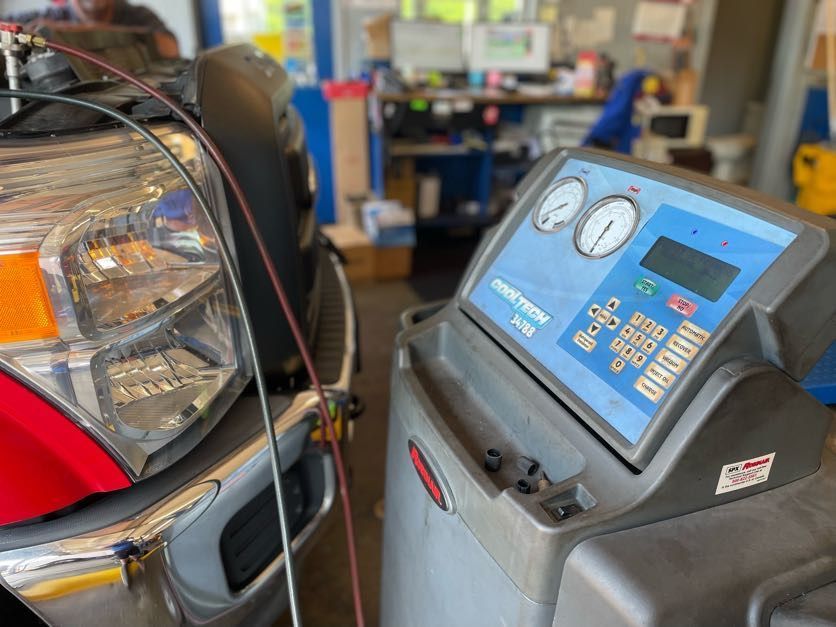
You should not have to choose between sitting in a sweatbox and driving in circles just to stay cool. At Jamie's Tire & Service, we specialize in diagnosing these tricky A/C issues. We don't just add more gas and hope for the best. We perform a full system check that includes testing your fan speeds, inspecting your condenser for blockages, and measuring the high and low side pressures at both idle and highway speeds.
If your car is losing its cool at stoplights, we invite you to any Jamie's Tire & Service location today and let us give you a professional evaluation.
- Jamie's Tire & Service Beavercreek, 2276 Grange Hall Road, Beavercreek
- Jamie's Express, 1276 Sterling Court, Fairborn
- Jamie's Tire & Service Xenia, 213 West Main Street, Xenia, OH 45385
- Jamie's Tire & Service Kettering, 3050 Woodman Drive, Kettering, OH
- Jamie's Tire & Service Fairborn, 31 South Broad Street, Fairborn, OH
- Jamie's Tire & Service Northtown, 4220 North Main Street, Dayton, OH
- Jamie's Tire & Service Northridge, 6104 North Dixie Drive, Dayton, OH